
EV disputes brought by consumers to The Motor Ombudsman in 2026
Overview of EV disputes brought to The Motor Ombudsman relative to UK new car registrations and the overall automotive parc
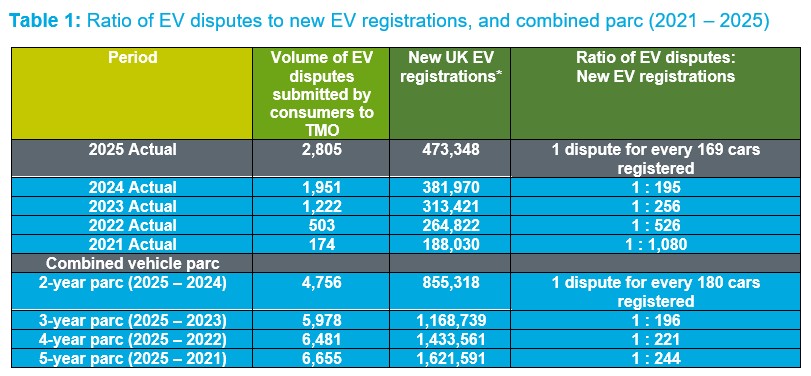
Before exploring the profile and volume of electric vehicle (EV) disputes received by The Motor Ombudsman from consumers, it is important to understand the trend of EV disputes in relation to both EV and non-EV new car registrations (i.e. petrol, diesel and hybrid models), and the overall EV and non-EV vehicle parc.
When looking at the proportion of disputes received by The Motor Ombudsman versus new registrations on an annual basis for electric vehicles and non-electric models (i.e. petrol diesel and hybrid), as shown in Tables 1 and 2, it is possible to conclude that EVs generate far fewer complaints per vehicle than non-EV equivalents. For example, based on the latest 2025 full-year data, EVs were generating one dispute for every 169 cars, compared to one in every 26 vehicles for a petrol, diesel, or hybrid variant.
A similar picture can also be seen when comparing the volume of EV disputes to the combined car parc, with the two-year combined parc equating to one complaint in every 180 cars, which decreases to one in every 244 for the five-year combined parc.
In contrast, for ICE and hybrid equivalent models (see Table 2), there is one dispute in every 32 cars for the two-year combined parc, which drops to one in every 48 vehicles for the five-year combined parc, highlighting the variation between these fuel types.
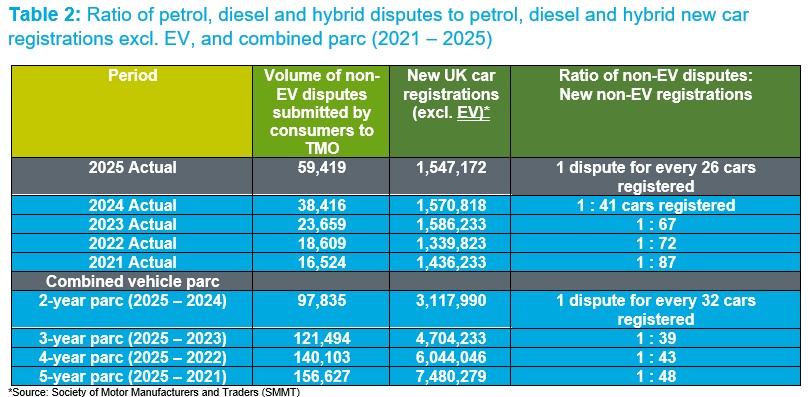
The ratio of non-EV disputes received by The Motor Ombudsman (59,419) to new non-EV registrations (1,547,172) stands at one dispute for every 26 new non-EVs registered.
Overview of EV disputes received in 2026
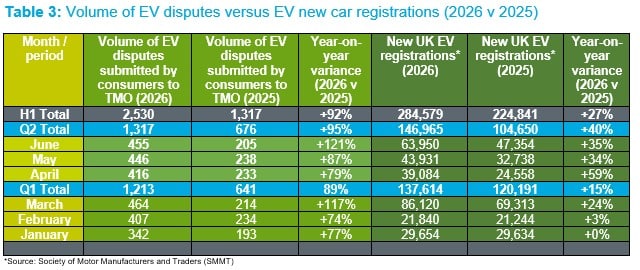
Disputes raised about electric vehicles in the second quarter of 2026 nearly doubled when compared to the same period a year earlier, rising by 95% from 676 to 1,317 for the April to June period. This also represents the highest ever quarterly total for EV disputes submitted by consumers.
Across the quarter, volumes increased year-on-year in each month, with April seeing 416 new EV case submissions compared with 233 in 2025 (+79%), May rose from 238 to 446 (+87%), and June recorded the sharpest uplift, climbing from 205 to 455 disputes (+121%).
This notable year-on-year increase in EV complaints reflects the rising number of motorists opting for this fuel type, alongside record levels of consumers turning to The Motor Ombudsman for assistance. It also comes against a backdrop of greater use of Artificial Intelligence (AI), which is signposting more individuals to The Motor Ombudsman for help with their complaints, and the continued financial pressures facing households across the UK.
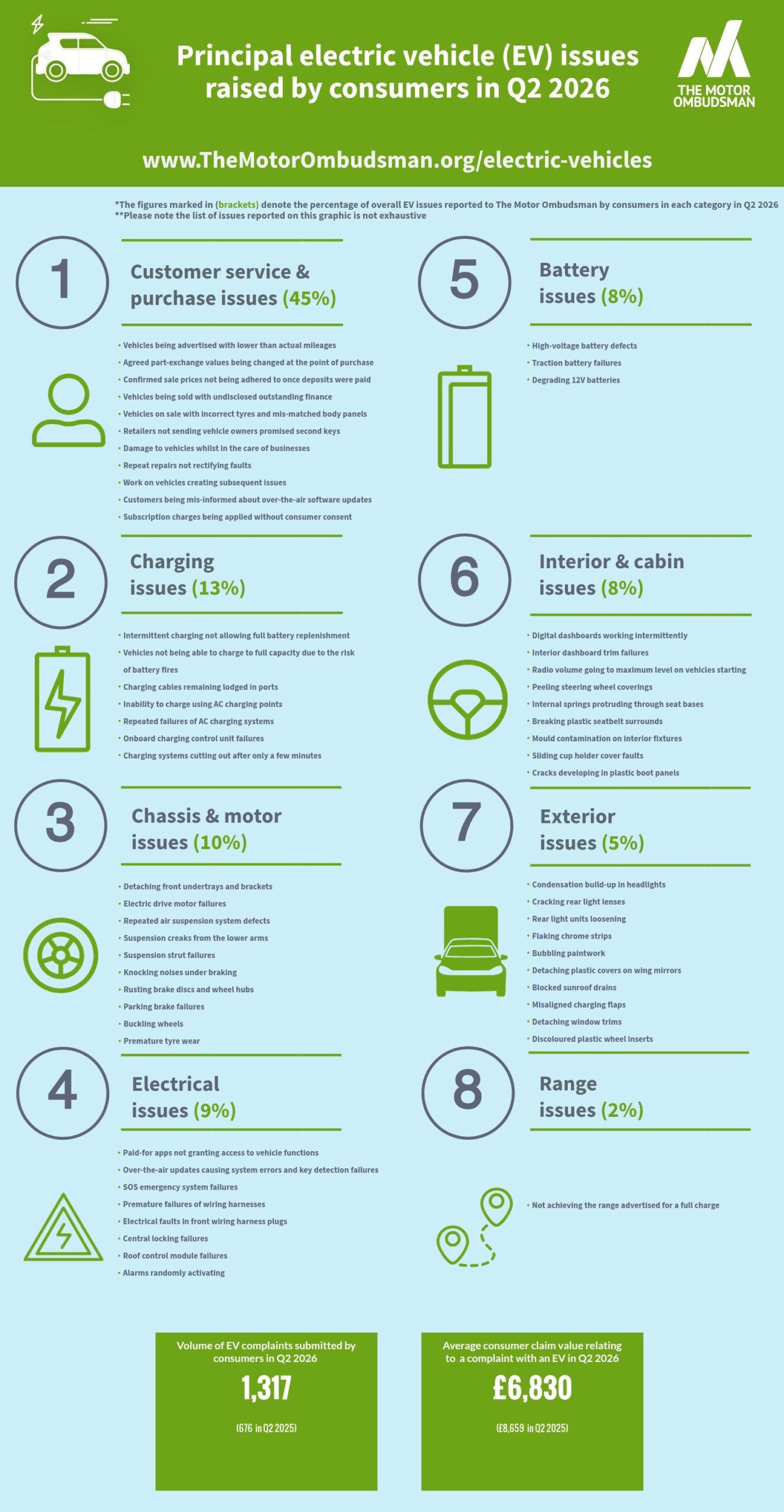
The main issues reported by consumers with an EV during the second quarter of 2026 are outlined below:
1. Customer service and purchase issues (45%)
The standard of customer service offered by retailers remained the leading source of EV disputes, making up nearly half of cases submitted by consumers between April and June. During the purchase process, motorists reported issues such as vehicles being advertised with lower than actual mileages, agreed part-exchange values being changed by sellers, and confirmed sale prices not being adhered to once deposits were paid by consumers.
After taking delivery of their EV, individuals also expressed concern about repeat repairs not rectifying faults, work on vehicles creating subsequent issues, being mis-informed about over-the-air software updates, and subscription charges being applied without prior consent.
2. Charging issues (13%)
Charging-related concerns remained prominent, driving 13% of case submissions in the second quarter. Motorists reported being unable to replenish their EV batteries to full capacity due to a fire risk, which in turn caused discontent about their ability to use vehicles to their full potential. Other issues raised in this category, were namely charging cables remaining lodged in ports, repeated failures of AC charging systems, and charging cutting out after only a few minutes of connection.
3. Chassis and motor issues (10%)
Chassis and motor problems expressed by consumers between April and June of this year, accounted for a tenth of electric vehicle case submissions. Examples of problems which were highlighted, took in the likes of detaching front undertrays and brackets, electric drive motor failures, repeated air suspension system defects, and creaks from the lower arms. Similarly, complaints were also made about parking brake failures, buckling wheels, and premature tyre wear.
4. Electrical issues (10%)
Electrical systems within an EV play a vital role in the vehicle’s operation, meaning faults can create significant inconvenience for owners. Key concerns that came to the fore in Q2, included paid-for apps not granting access to vehicle functions, over-the-air updates causing system errors and key detection failures, as well as wiring harnesses ceasing to function prematurely.
Vehicle owners equally reported electrical faults in front wiring harness plugs, central locking and roof control modules failing, as well as car alarms activating on random occasions.
5. Battery issues (8%)
Battery-related concerns were the fifth most notable area of dissatisfaction for EV owners, representing 8% or 108 of the 1,317 disputes logged by motorists during the second quarter of 2026. The principal issues raised by consumers were focused on high-voltage battery defects, traction battery failures, and degrading 12V batteries.
6. Interior and cabin systems issues (8%)
The interior and systems in the cabin also accounted for 8% of EV disputes in Q2, with motorists highlighting a wide range of concerns that affected both comfort and day-to-day usability. Some of the issues emanated from in-car cabin technology, including digital dashboards that worked intermittently, and radio volume levels unexpectedly rising to maximum when vehicles were started. Others related to the quality and durability of cabin fixtures and fittings, with consumers reporting dashboard trim failures, peeling steering wheel coverings, broken plastic seatbelt surrounds, and sliding cup holder covers that no longer operated as intended.
Complaints also extended to internal springs protruding through seat bases, mould contamination on interior fixtures, and cracks developing in plastic boot panels.
7. Exterior issues (5%)
Exterior-related concerns accounted for 5% of EV disputes in Q2, with motorists touching on issues that affected both the appearance and practicality of their vehicles. Some complaints focused on lighting, including condensation building up in headlights, cracks developing in rear light lenses, and units becoming loose over time.
Drivers also expressed dissatisfaction regarding flaking chrome strips and bubbling paintwork, plastic covers detaching from wing mirrors, window trims coming away, and discoloured plastic wheel inserts. Furthermore, consumers reported faults, such as blocked sunroof drains and misaligned charging flaps.
8. Range issues (2%)
Finally, disputes relating to the range quoted for a single full charge remained comparatively low in Q2, accounting for just 2% of complaints. This continues to reflect the established pattern seen for this aspect of EV ownership, where range-related concerns represent only a small proportion of the overall issues raised by consumers.
Average consumer claim value
For consumers who stated a monetary value to resolve their complaint with a business, the average stood at £6,830 for Q2 2026, which is around 20% lower than the figure recorded for the same three-month period in 2025 (£8,659).
To view and download The Motor Ombudsman’s thought leadership paper on electric vehicle disputes as a PDF, please click here.