
EV disputes brought by consumers to The Motor Ombudsman in Q1 2026
Overview of EV disputes brought to The Motor Ombudsman relative to UK new car registrations and the overall automotive parc
Before exploring the profile and volume of electric vehicle (EV) disputes received by The Motor Ombudsman from consumers, it is important to understand the trend of EV disputes in relation to both EV and non-EV new car registrations (i.e. petrol, diesel and hybrid models), and the overall EV and non-EV vehicle parc.
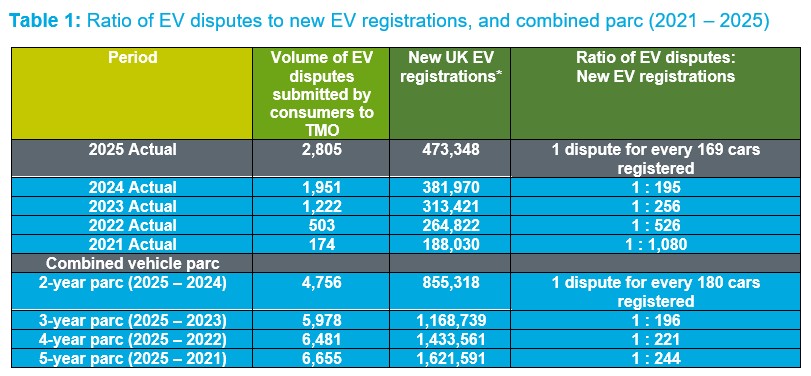
When looking at the proportion of disputes received by The Motor Ombudsman versus new registrations on an annual basis for electric vehicles and non-electric models (i.e. petrol diesel and hybrid), as shown in Tables 1 and 2, it is possible to conclude that EVs generate far fewer complaints per vehicle than non-EV equivalents. For example, based on the latest 2025 full-year data, EVs were generating one dispute for every 169 cars, compared to one in every 26 vehicles for a petrol, diesel, or hybrid variant.
A similar picture can also be seen when comparing the volume of EV disputes to the combined car parc, with the two-year combined parc equating to one complaint in every 180 cars, which decreases to one in every 244 for the five-year combined parc.
In contrast, for ICE and hybrid equivalent models (see Table 2), there is one dispute in every 32 cars for the two-year combined parc, which drops to one in every 48 vehicles for the five-year combined parc, highlighting the variation between these fuel types.
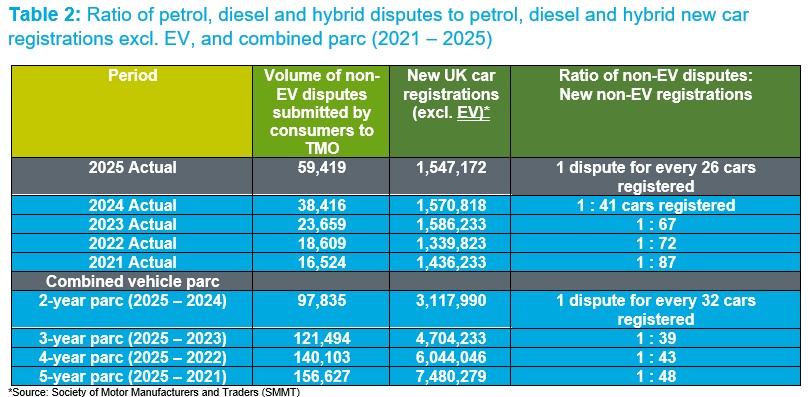
The ratio of non-EV disputes received by The Motor Ombudsman (59,419) to new non-EV registrations (1,547,172) stands at one dispute for every 26 new non-EVs registered.
Overview of EV disputes received in Q1 2026
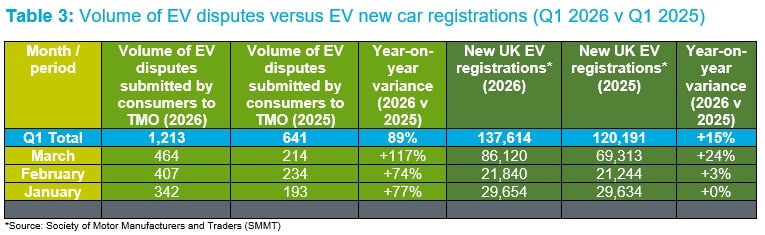
Disputes raised about EVs in the first quarter of 2026 was nearly double the volume (89%) seen in the opening three months of 2025 (1,213 versus 641). It is also a new record-high for a single quarter, whilst it is also the first time that EV disputes have surpassed the 1,000 threshold for this period for the first time.
The increase in EV complaints reflects the rising ownership of this fuel type, and the record numbers of consumers contacting The Motor Ombudsman for assistance, against a backdrop of a growing use of Artificial Intelligence (AI), which is signposting individuals to The Motor Ombudsman to get help with their complaint, as well as the continued financial strain facing households.
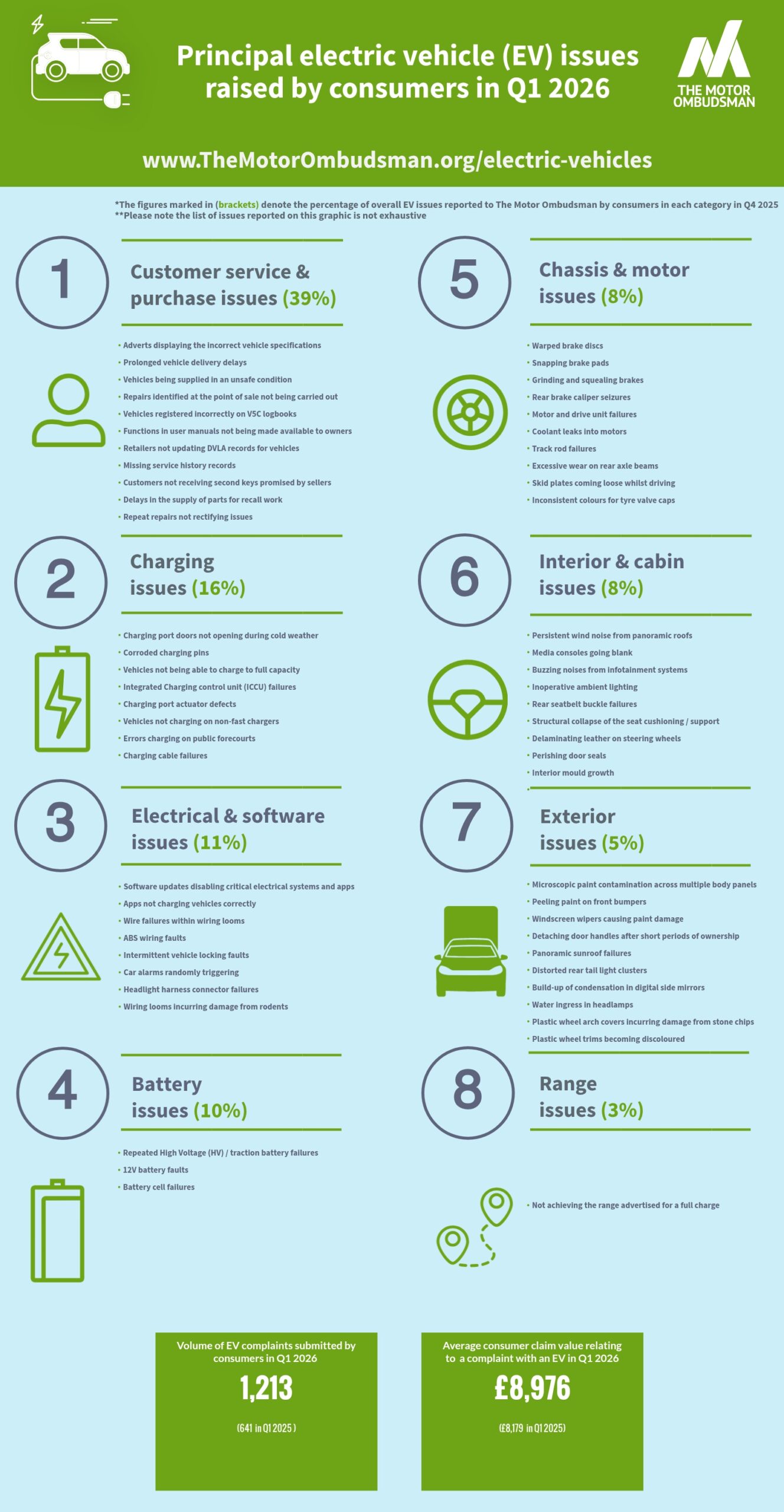
When looking at the main issues encountered by consumers with an EV during the first quarter of 2026, they are as follows:
1. Customer service and purchase issues (39%)
Customer service concerns once again dominated disputes, at just over a third of those submitted by consumers between January and March. At the point of purchase, issues raised included the likes of adverts displaying incorrect vehicle specifications, deliveries taking longer than scheduled, and repairs identified at the time of sale not being carried out prior to handover.
Having taken ownership of an EV, complaints were driven by problems, such as consumers not receiving a second key promised by retailers, delays to parts being made available for recall repairs, and repeated attempts to fix an issue that did not deliver a solution.
2. Charging issues (16%)
Charging issues became more prominent in the second quarter due to concerns from motorists about not being able to replenish the battery to its full capacity, thereby affecting usage of their vehicle. Other charging-related problems reported in this category during the first quarter of 2026 were namely, charging port actuator defects, errors charging on public forecourts and non-fast chargers, and charging cables not working, thereby inhibiting their use.
3. Electrical and software issues (11%)
The electrical infrastructure of an EV is critical to the functioning of the vehicle, where failures can cause notable inconvenience to owners. Examples of some of the principal concerns raised between January and March were, software updates and apps disabling systems, failures within wiring looms, car alarms randomly triggering without being readily activated, as well as intermittent vehicle locking faults.
4. Battery issues (10%)
Battery problems were the fourth biggest cause of disputes during the first quarter of 2026, at 10% of the 1,213 logged by motorists. Amongst the main issues highlighted by consumers, stemmed from 12V and high-voltage battery faults, and battery cell failures affecting power delivery.
5. Chassis & Motor issues (8%)
Chassis and motor issues were less prominent during the first three months of the year compared to Q4 in 2025 (14%), which is encouraging to see. Instances of concerns brought to the attention of The Motor Ombudsman originated from factors such as, brake calipers seizing, warped discs, and snapping pads. In terms of the motors, consumers reported coolant leaks on to the hardware, as well as drive unit failures. Skid plates coming loose, and non-matching tyre valve caps equally plagued drivers at the start of this year.
6. Interior and cabin systems issues (8%)
The interior and systems in the cabin also accounted for 8% of EV disputes in Q1. For in-car systems, consumers stated in their submissions to The Motor Ombudsman that media consoles went blank, infotainment screens buzzed, and ambient lighting ceased to work. When looking at seating, owners stated that the cushioning and support collapsed causing inherent discomfort, whilst rear seatbelt buckles also failed. In addition, motorists witnessed perishing door seals, and mould growth from water ingress.
7. Exterior issues (5%)
On to the exterior panels, and paintwork proved problematic for some consumers. Dissatisfaction resulted from contamination, and peeling paint on bumpers. Other issues reported were namely, the build-up of moisture in digital side mirrors and headlamps, detaching door handles, distorted rear light clusters, and plastic wheel trims becoming discoloured.
8. Range issues (3%)
Lastly, disputes surrounding the quoted range that can be achieved on a single full charge remained low in Q1 at less than 5% of complaints, mirroring the continued underlying trend for this aspect of EV ownership.
Average consumer claim value
For consumers who stated a monetary value to resolve their complaint with a business, the average stood at £8,976 for Q1 2026, which was around 10% higher than the figure recorded for the same three-month period in 2025 (£8,179).
To view and download The Motor Ombudsman’s thought leadership paper on electric vehicle disputes as a PDF, please click here.