
EV disputes brought by consumers to The Motor Ombudsman in 2026
Overview of EV disputes brought to The Motor Ombudsman relative to UK new car registrations and the overall automotive parc
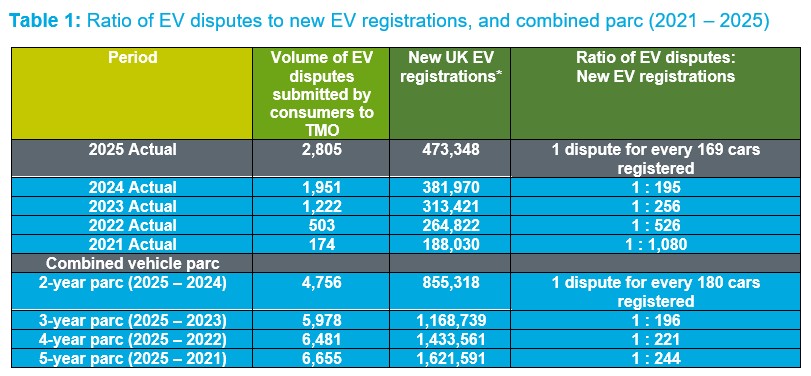
Before exploring the profile and volume of electric vehicle (EV) disputes received by The Motor Ombudsman from consumers, it is important to understand the trend of EV disputes in relation to both EV and non-EV new car registrations (i.e. petrol, diesel and hybrid models), and the overall EV and non-EV vehicle parc.
When looking at the proportion of disputes received by The Motor Ombudsman versus new registrations on an annual basis for electric vehicles and non-electric models (i.e. petrol diesel and hybrid), as shown in Tables 1 and 2, it is possible to conclude that EVs generate far fewer complaints per vehicle than non-EV equivalents. For example, based on the latest 2025 full-year data, EVs were generating one dispute for every 169 cars, compared to one in every 26 vehicles for a petrol, diesel, or hybrid variant.
A similar picture can also be seen when comparing the volume of EV disputes to the combined car parc, with the two-year combined parc equating to one complaint in every 180 cars, which decreases to one in every 244 for the five-year combined parc.
In contrast, for ICE and hybrid equivalent models (see Table 2), there is one dispute in every 32 cars for the two-year combined parc, which drops to one in every 48 vehicles for the five-year combined parc, highlighting the variation between these fuel types.
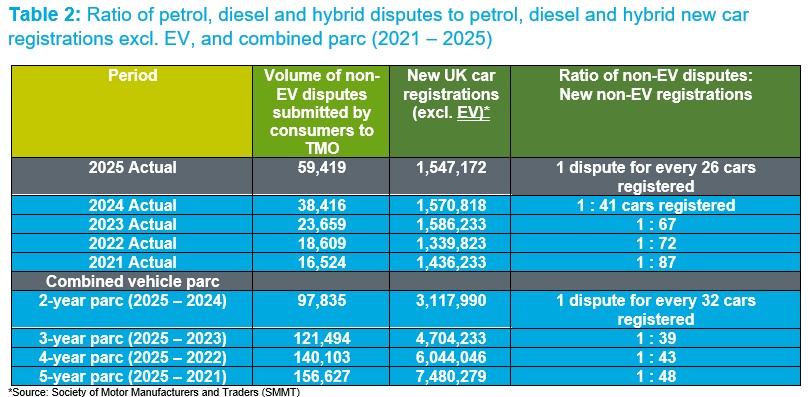
The ratio of non-EV disputes received by The Motor Ombudsman (59,419) to new non-EV registrations (1,547,172) stands at one dispute for every 26 new non-EVs registered.
Overview of EV disputes received in 2026
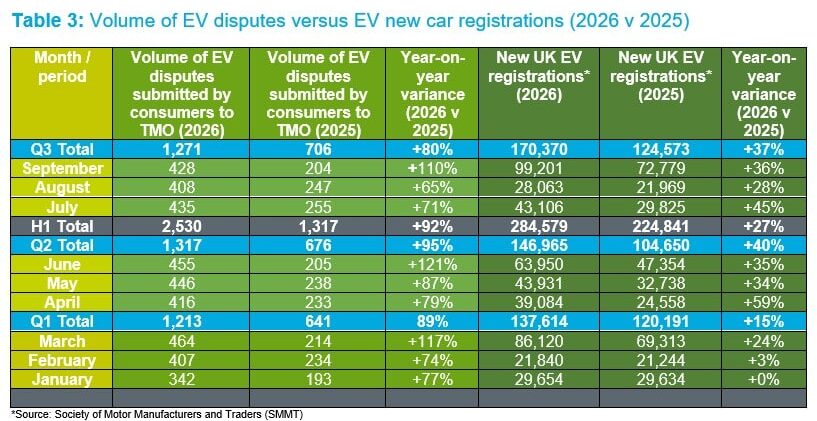
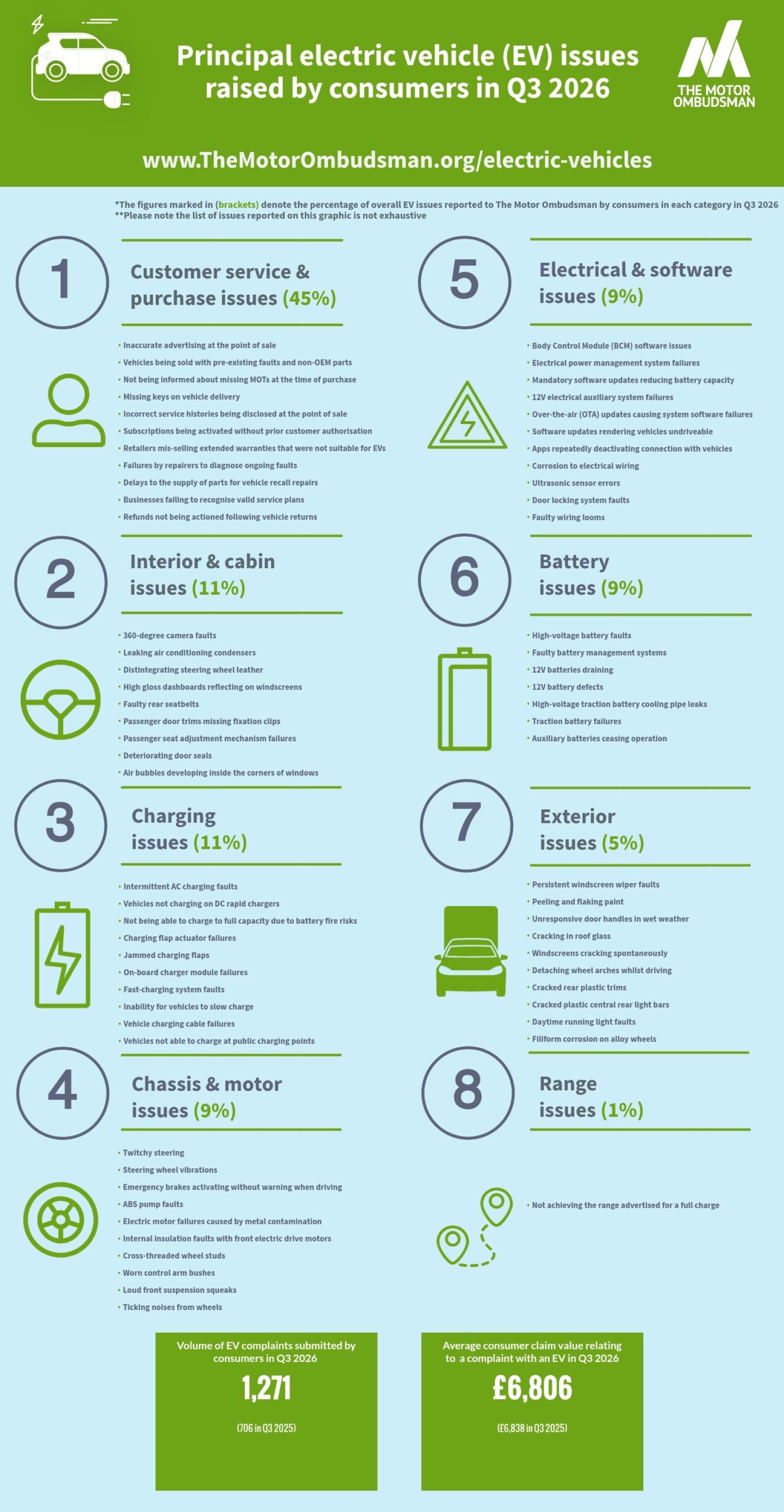
Electric vehicle disputes rose by 80% in the third quarter of 2026 compared with the same period in 2025 (1,271 versus 706 respectively). However, the quarterly total remained below the record quarterly high reached earlier in Q2 (1,317), reflecting a modest easing in complaint volumes, which was likely due to the summer break.
This notable year-on-year increase in EV complaints reflects the rising number of motorists opting for this fuel type, alongside record levels of consumers turning to The Motor Ombudsman for assistance. It also comes against a backdrop of greater use of Artificial Intelligence (AI), which is signposting more individuals to The Motor Ombudsman for help with their complaints, and the continued financial pressures facing households across the UK.
The main issues reported by consumers with an EV during the third quarter of 2026 are outlined below:
1. Customer service and purchase issues (45%)
Customer service and purchase issues remained the leading source of EV disputes in Q3 2026, accounting for nearly half (45%) of the 1,271 cases submitted during the three-month period. Consumers reported issues throughout their purchase and ownership journey, including vehicles being delivered with missing specification, undisclosed aftermarket components, inaccurate advertising and service histories, as well as delays to vehicle deliveries. When it came to maintenance, customers expressed concerns, such as waiting prolonged periods for repairs coupled with the availability of replacement parts, as well as retailers failing to honour valid service plans.
2. Interior and cabin systems issues (11%)
When it came to the interior of EVs, concerns ranged from failures of in-car systems, such as air conditioning, infotainment, satellite navigation and 360-degree camera displays.
In terms of the cabin equipment, owners encountered problems with seat adjustment, whilst from an aesthetic point of view, there was degradation of the leather covering on the steering wheel, door trims missing fixation clips causing them to come loose, and glossy dashboards reflecting in windscreens inhibiting visibility.
In addition, consumers equally expressed dissatisfaction with deteriorating door seals and air bubbles developing in the inside corners of windows.
3. Charging issues (11%)
Around a tenth (11%) of EV disputes in the third quarter stemmed from issues when it came to charging a vehicle, which is a critical element to its operation. Owners made reference to the fact that there was either an inability to slow or fast charge, charging flap actuator failures, charging module faults, and not being able to conduct a full charge due to the risk of battery fires. On the topic of accessories, consumers equally reported charging cables breaking, preventing the use of charging points when replenishment was needed.
4. Chassis and motor issues (9%)
The next most prominent driver of disputes in Q3 was the chassis and motor area of an EV. Within their case submissions, individuals pointed out that steering was subject to vibrations, emergency braking systems activated without warning, whilst ABS pumps also stopped working. Similarly, consumers encountered worn control arm bushes, loud squeaks emanating from the front suspension, and ticking noises from wheels.
5. Electrical and software issues (9%)
Following closely behind the aforementioned category were electrical concerns, relating to the vehicle’s infrastructure itself or to software faults. Examples of problems encountered by owners were namely, electrical power management system failures, software updates rendering vehicles unusable, and reducing battery capacity. In addition, consumers equally stated the presence of corrosion on electrical wiring, faulty looms, and door locking system faults.
6. Battery issues (9%)
On the subject of batteries – a critical source of power for EVs, high-voltage battery failures, and leaks from coolant pipes plagued drivers during the third quarter of this year, as did faulty battery management systems. Other concerns focused on 12V batteries draining or failing, whilst auxiliary batteries also stopped working, causing inconvenience to owners.
7. Exterior issues (5%)
The bodywork and associated external equipment was another source of discontent for 5% of consumers who submitted an EV-related dispute in the third quarter. Issues spanned peeling and flaking paint, and cracked plastic central lightbars, trim and roof glass, to discovering corrosion on alloy wheels, and unresponsive door handles in wet weather. Consumers equally raised the fact that their vehicle had suffered from persistent wiper defects and windscreens cracking spontaneously.
8. Range issues (1%)
Range issues remained the least prominent source of EV disputes during the July to September period, accounting for just 1% of all cases submitted to The Motor Ombudsman during this time. Complaints principally resulted from vehicles not achieving the mileage promoted for a full charge.
The low proportion of complaints in this area suggests that range itself is not a widespread cause of formal disputes, and factors affecting it are becoming more widely understood or explained at the point of purchase, where many will be first-time owners of EVs.
Average consumer claim value
For consumers who stated a monetary value to resolve their complaint with a business, the average stood at £6,806 for Q3 2026, which mirrors the figure recorded for the same three-month period in 2025 (£6,838).
To view and download The Motor Ombudsman’s thought leadership paper on electric vehicle disputes as a PDF, please click here.