
EV disputes brought by consumers to The Motor Ombudsman in Q4 2025 / FY 2025
Overview of EV disputes brought to The Motor Ombudsman relative to UK new car registrations and the overall automotive parc
Before exploring the profile and volume of electric vehicle (EV) disputes received by The Motor Ombudsman from consumers, it is important to understand the trend of EV disputes in relation to both EV and non-EV new car registrations (i.e. petrol, diesel and hybrid models), and the overall EV and non-EV vehicle parc.
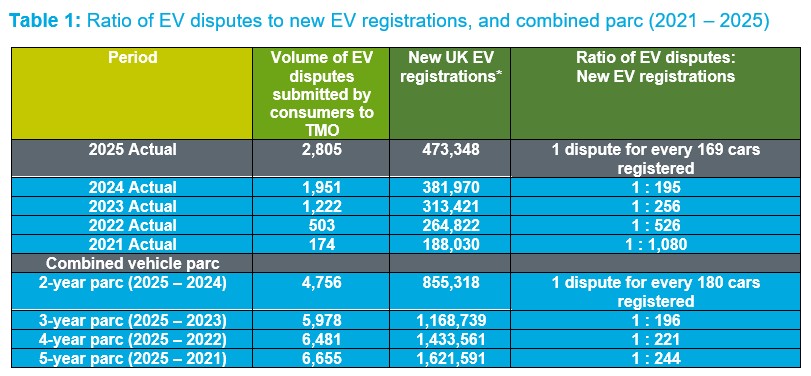
When looking at the proportion of disputes received by The Motor Ombudsman versus new registrations on an annual basis for electric vehicles and non-electric models (i.e. petrol diesel and hybrid), as shown in Tables 1 and 2, it is possible to conclude that EVs generate far fewer complaints per vehicle than non-EV equivalents. For example, based on the latest 2025 full-year data, EVs were generating one dispute for every 169 cars, compared to one in every 26 vehicles for a petrol, diesel, or hybrid variant.
A similar picture can also be seen when comparing the volume of EV disputes to the combined car parc, with the two-year combined parc equating to one complaint in every 180 cars, which decreases to one in every 244 for the five-year combined parc.
In contrast, for ICE and hybrid equivalent models (see Table 2), there is one dispute in every 32 cars for the two-year combined parc, which drops to one in every 48 vehicles for the five-year combined parc, highlighting the variation between these fuel types.
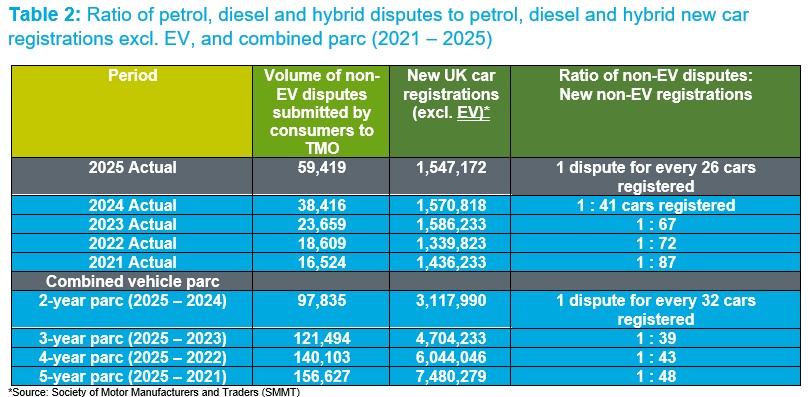
The ratio of non-EV disputes received by The Motor Ombudsman (59,419) to new non-EV registrations (1,547,172) stands at one dispute for every 26 new non-EVs registered.
Volume of EV disputes received in 2025
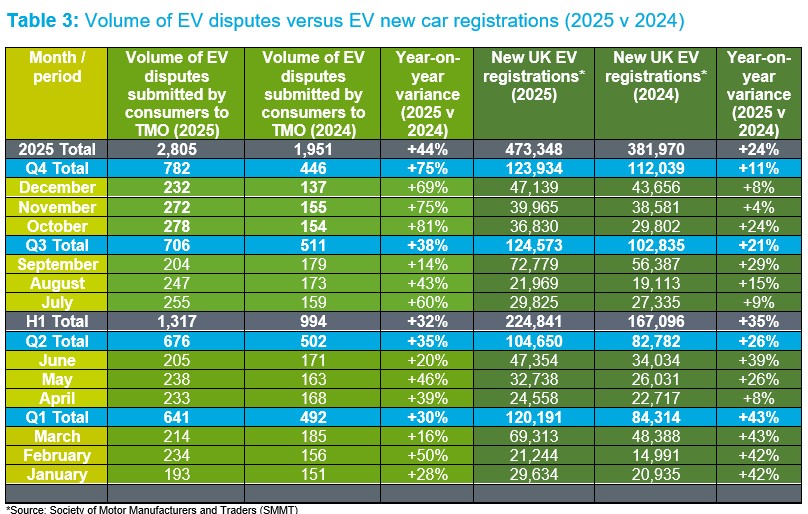
In 2025, the number of cases submitted by consumers neared the 3,000 mark, with 2,805 recorded in the last 12 months – an increase of 44% versus the figure seen in 2024 (as shown in Table 3 below). This, however, represents less than 5% of all cases opened with The Motor Ombudsman by consumers in 2025 (around 62,000), and fewer than 1% of the total contacts received during the year (265,000).
Similarly, the volume of EV disputes recorded by The Motor Ombudsman in a single calendar year also surpassed 2,000 for the first time, highlighting the growing parc and uptake of new and used pure battery electric models by consumers during 2025 versus the previous calendar year.
Overview of EV disputes received in Q4 2025
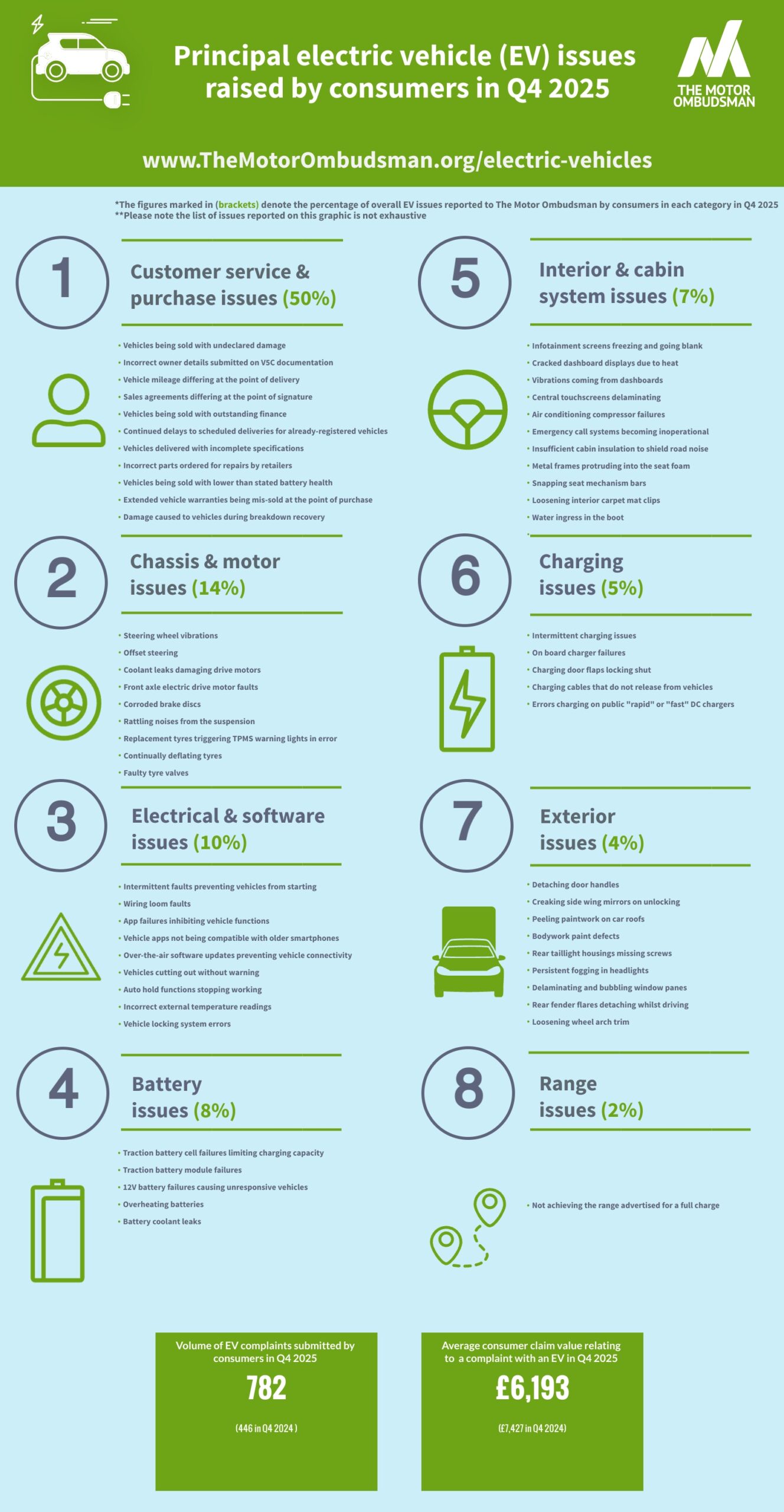
During the final quarter of 2025, The Motor Ombudsman received a total of 782 EV disputes – the highest quarterly tally ever recorded, and was an equivalent increase of 75% when compared to the statistic witnessed in Q4 2024 (446), reinforcing the year-on-year upward trend that will likely continue through 2026.
When looking at the main issues encountered by consumers with an EV during the final quarter of 2025, they are as follows:
1. Customer service and purchase issues (50%)
Mirroring the continued trend seen in previous quarters, customer service concerns during a consumer’s purchase and ownership journey, drove half of all complaints about electric vehicles in Q4. Instances reported were namely, undeclared damage, and inaccurate battery health records by retailers, incorrect new owner details being submitted on V5C logbooks, and purchase agreements differing from what was agreed with buyers. Motorists equally expressed dissatisfaction about damage being caused during the recovery of vehicles for repairs.
2. Chassis and motor issues (14%)
Issues in relation to the chassis, motor and transmission areas of an EV were the second most prominent driver of disputes during the past three months, at 14%. Discontent stemmed from factors, such as offset steering and vibrations, faults with electric drive motors preventing the use of vehicles, corroded brake discs, and rattling noises from the suspension. In addition, concerns were also raised in relation to tyres deflating on a regular basis, as well as replacement tyres triggering warning lights in error.
3. Electrical and software issues (10%)
Reflecting what was seen in Q3 2025, electrical and software issues once again made up a tenth of the complaints about EVs that were brought to The Motor Ombudsman’s attention between October and December. These resulted from problems with wiring looms and locking systems, apps and software upgrades inhibiting vehicle functions, and power cutting out without warning, or vehicles simply being unable to start.
4. Battery issues (8%)
Batteries are a critical part of vehicle systems, meaning faults can hamper usage. Disputes in this category were largely centred around traction battery module and cell failures, in addition to 12V battery faults and coolant leaks.
5. Interior and cabin systems issues issues (7%)
The cabin area and in-car systems saw a slightly smaller proportion of complaints than batteries. Consumers expressed dissatisfaction about key areas of the interior, after infotainment screens froze and delaminated, air conditioning systems stopped working, seat mechanisms snapped, and damage caused by water leaking into the boot area. Some owners equally deemed the cabin insulation to be inadequate when it came to the degree of shielding from road noise.
6. Charging issues (5%)
Charging concerns were generally few and far between during the past three months, making up just 5% of disputes. Sources of owner frustration resulted from intermittent charging faults, on-board charging failures, port flaps locking shut, and being unable to access rapid and public roadside chargers to replenish batteries.
7. Exterior issues (4%)
Problems concerning the exterior of an EV fell slightly from 5% of EV disputes logged in Q3 2025, which is a positive takeaway from the latest data. For consumers who reported issues about this area of their vehicle, these originated from, but were not limited to factors, such as door handles detaching, the discovery of paint defects, lights fogging and missing fixings, and bubbling window panes.
8. Range issues (2%)
Although it consistently makes up the smallest volume of complaints specific to battery electric vehicles, the actual range recorded for a full charge not matching the advertised figure, which can be driven by a multitude of factors, was the primary reason for drivers raising a dispute with The Motor Ombudsman for this element of EV ownership.
Average consumer claim value
For consumers who stated a monetary value to resolve their complaint with a business, the average stood at £6,193 for Q4 2025, which was 17% lower than the figure recorded for the same three-month period in 2024 (£7,427).
To view and download The Motor Ombudsman’s thought leadership paper on electric vehicle disputes as a PDF, please click here.