

The Motor Ombudsman provides information to help consumers understand tyre condition and the factors to consider when replacement is necessary. When tyres need replacing, buying new from a reputable accredited retailer can provide greater certainty about their condition, age and remaining lifespan.
What are part-worn tyres?
Part-worn tyres are tyres that have previously been fitted to a vehicle and used on the road before being removed and offered for sale again. They may then be sold separately and fitted to another vehicle.
They can legally be sold in the UK provided they meet specific safety, condition and labelling requirements. However, compliance with the minimum legal standard does not provide a complete picture of how a tyre has previously been driven, maintained, repaired or stored.
A part-worn tyre’s condition can vary considerably. One tyre may have substantial tread remaining, while another may be much closer to the minimum permitted for resale. Age, previous tyre pressures, wheel alignment, driving history, impacts, and repairs, can also influence their condition.
A visual inspection can reveal some problems, although it cannot necessarily establish everything that has happened to a tyre during its previous use.
Tyres fitted to used vehicles are also technically part-worn, as they have already covered mileage under a previous owner. However, the term is more commonly used for second-hand tyres that have been removed from one vehicle and offered for sale again.
Why do people buy part-worn tyres?
Price is one of the main reasons motorists consider used tyres.
The Motor Ombudsman’s 2026 research into second-hand shopping found that 31% of UK adults surveyed would consider buying part-worn tyres rather than new ones if their vehicle needed replacement tyres.
Among those respondents, 67% cited saving money as the main reason, while 37% regarded part-worn tyres as a temporary measure until they could afford new tyres.
A lower purchase price can therefore appear attractive when household and motoring costs are being closely managed. However, the amount paid for a tyre needs to be considered alongside how much usable life remains and the uncertainty surrounding its previous history.
A cheaper tyre with substantially less tread remaining may also need replacing sooner than a new equivalent. Condition, age and suitability for the vehicle should therefore form part of the consideration rather than price alone.
Are part-worn tyres legal in the UK?
Yes. Selling and fitting part-worn tyres is legal in the UK, although tyres offered for sale must meet requirements covering their condition, tread depth, testing and markings.
The rules for selling part-worn tyres are stricter than the general minimum tread requirements applying to a tyre already being used on a car. For cars, light vans and light trailers, the general legal minimum is 1.6mm across the central three-quarters of the tread and around its entire circumference.
A part-worn tyre being offered for sale must have at least 2mm of tread across the full breadth of the original tread pattern and around its entire circumference.
The rules sellers must follow
Part-worn tyres must satisfy a number of requirements before being supplied.
Among other conditions, a tyre should not have certain cuts deep enough to reach the ply or cord, internal or external lumps, bulges or tears caused by structural separation, or exposed ply or cords. Penetration damage must have been properly repaired. The tyre must also have passed an inflation test before sale.
For most part-worn tyres that have not been retreaded, the appropriate approval marking should also be present.
Compliance cannot always be assumed simply because a tyre is available commercially. DVSA’s 2024 market-surveillance programme bought 53 part-worn tyres from sellers and found five to be unroadworthy. Only two of the 53 were correctly marked as part-worn.
This helps illustrate why the condition and provenance of a used tyre deserve careful consideration.
What “PART-WORN” labelling means and why many buyers miss it
Tyres sold as part-worn must carry the words “PART-WORN” permanently and legibly on the sidewall in uppercase letters at least 4mm high.
The marking identifies a tyre as part-worn and is one of the legal requirements sellers must meet when supplying these tyres.
Awareness of this requirement remains relatively low. The Motor Ombudsman’s 2026 survey found that 43% of respondents did not know sellers were required to mark part-worn tyres in this way.
A part-worn tyre offered for sale without this marking would therefore not meet the labelling requirement. The presence of the marking, however, does not tell a buyer how the tyre was previously driven, maintained or stored.
Are part-worn tyres safe?
A legally compliant part-worn tyre may still have usable life remaining, although buying one can involve more uncertainty than choosing a new tyre.
Tyres are the vehicle’s only point of contact with the road, so their condition can affect braking, steering, stability and grip in wet weather. Part-worn tyres can also carry additional risks because their previous use, maintenance and repair history may be difficult for a buyer to establish.
Stuart Lovatt, Chair at TyreSafe, explains:
“Millions of part-worn tyres enter the market every year with an unknown history. They may appear great value on the surface, but they can unfortunately compromise braking performance, increase the risk of blowouts, and put road users at risk of serious harm.”
There may also be problems that are difficult to identify from the outside. A tyre could have undergone an internal repair, for example, while previous exposure to incorrect tyre pressures, impacts or other stresses may not be apparent during a basic visual check.
For this reason, tread depth and appearance only provide part of the picture when assessing the condition of a part-worn tyre.
The hidden history problem
One of the principal difficulties with a part-worn tyre is establishing what happened before it reaches the buyer.
A tyre may previously have been driven for thousands of miles at the wrong pressure, fitted to a vehicle with alignment problems, struck potholes or kerbs, carried heavy loads or undergone repairs. Storage conditions can also vary once a tyre has been removed.
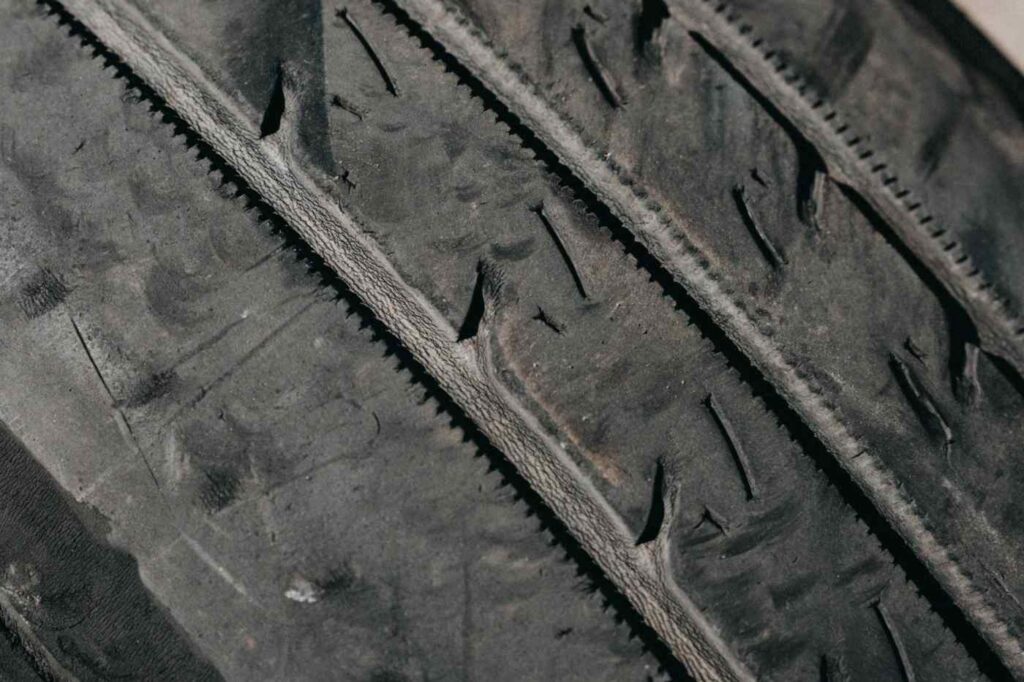
Some damage is visible from the outside. Cuts, cracking, bulges, exposed cords and uneven tread wear can indicate that further assessment is needed. Other issues may be harder for a consumer to identify.
A part-worn tyre may also have undergone an internal repair that is difficult to identify from the outside, making its previous condition and repair history harder to judge during a basic visual inspection.
DVSA investigations have previously identified part-worn tyres with penetrating objects, deep cuts, sidewall bulges and unacceptable repairs, reinforcing the importance of proper inspection before a tyre is resold.
How to read the DOT code
The DOT code found on a tyre sidewall can provide information about when the tyre was manufactured.
For motorists checking tyre age, the final four digits are particularly relevant. The first two indicate the week of manufacture and the final two show the year. A tyre marked “1825”, for example, was manufactured during the 18th week of 2025.
Age can be particularly important when assessing a part-worn tyre because a tyre may retain a reasonable amount of tread despite having been manufactured many years earlier.
The Motor Ombudsman’s research found that 69% of respondents did not know what the DOT code meant, suggesting many buyers may not currently use this information when assessing tyres.
Sidewall markings explained
A tyre sidewall contains considerably more information than its age.
Its sequence of letters and numbers can identify characteristics including tyre width, aspect ratio, construction, wheel diameter, load index and speed rating. These specifications help determine whether a tyre is appropriate for a particular vehicle.
Despite their importance, 51% of respondents to The Motor Ombudsman’s survey did not know what the letters and numbers on a tyre sidewall meant.
A tyre with plenty of tread may still be inappropriate if its size, load capacity or speed rating does not meet the vehicle manufacturer’s requirements. Checking the vehicle handbook or manufacturer information can help establish the correct tyre specification.
Tread depth and visible damage
Tread depth provides one of the clearest indicators of how much of a tyre’s usable tread remains.
For cars used on UK roads, the legal minimum tread depth is generally 1.6mm across the central three-quarters of the tyre and around its complete circumference.
Part-worn tyres must exceed this threshold when sold, with a minimum of 2mm across the full breadth of the tread and around the circumference.
Tread depth should also be considered alongside overall condition. Uneven wear, cracks, bulges, deep cuts, exposed cords or objects embedded in the tyre may point to damage or other problems. A tyre can therefore require attention despite remaining above the minimum tread depth.
Are part-worn tyres ever worth it? New vs part-worn tyres
Part-worn tyres can involve risks that are difficult for a buyer to assess, particularly where their previous use, maintenance, repairs and storage history are unknown. For this reason, The Motor Ombudsman recommends choosing new tyres from a reputable accredited tyre fitter and repairer where possible.
A new tyre begins its working life with no previous road use and a known condition. The buyer can select a tyre that meets the vehicle manufacturer’s required size, load and speed specifications and has a clear history from the point it is fitted.
With a part-worn tyre, some of its usable tread has already been consumed, while details of its earlier life may be limited. Even where it complies with the regulations governing resale, its remaining lifespan may be shorter and previous damage or repairs may be difficult to establish.
Part-worn tyres may have a lower initial purchase price, which can make them attractive when motorists are trying to reduce maintenance costs. However, this should be weighed against their remaining tread, potentially shorter lifespan and the uncertainty surrounding their previous use.
For motorists choosing between the two, new tyres can therefore provide greater certainty about condition, age and remaining usable life.
Find a reputable tyre fitter near you
Tyres play a direct role in a vehicle’s grip, braking and stability, making their condition an important part of routine vehicle maintenance. Although part-worn tyres can legally be sold when they meet the relevant requirements, their previous use and remaining lifespan can make them more difficult for consumers to assess with confidence.
If your tyres need replacing, The Motor Ombudsman recommends considering new tyres and having them supplied or fitted by a reputable business.
You can use The Motor Ombudsman’s Business Finder to locate nearby garages and tyre retailers and fitters that are accredited to its Service and Repair Code.
You can find more information around tyres and tyre maintenance in our related guides, such as how to change a tyre, the ultimate guide to run flat tyres and can you use winter tyres in summer?